2027


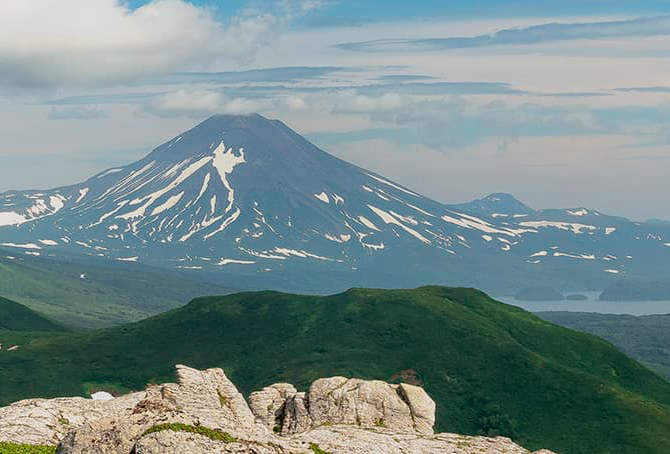
In 1956, the eruption of Bezymianny volcano shocked the entire world. Scientists even assigned a special classification to this event.
Bezymianny in Kamchatka is a volcanic mountain massif consisting of two parts: the younger Bezymianny itself and its older edifice, Proto‑Bezymianny. Study of its history and activity began in the 1980s, after the world witnessed a remarkably similar eruption of Mount St. Helens.
If you’re interested not only in reading about catastrophic eruptions but also in seeing the Valley of Giants and Bezymianny’s closest “neighbors” with your own eyes, take a look at our signature tour to Klyuchevskoy volcano without a mandatory ascent — the program is built around walks at the foot of Klyuchevskaya Sopka and the surrounding giants.
Detailed geological data were obtained by G. S. Gorshkov, while information about Bezymianny’s historical activity—shaping the volcano’s overall appearance and character—was compiled by G. E. Bogoyavlenskaya.
Researchers have found that over the last 2,500 years the volcano’s activity has been pulsating, with a regular change in the composition of volcanic rocks. Judging by past eruption cycles, Bezymianny is currently in the middle of an active phase that may last from 100 to 200 years. The style of its activity has also changed. About 1,400 years ago, eruptions began to take on a catastrophic character, and their power has been steadily increasing. Whereas earlier Bezymianny erupted more frequently but less violently, its modern eruptions are rarer but far more explosive. The most powerful in terms of blast energy and volume of erupted material was the 1956 event, which brought the volcano worldwide fame.
The 1956 eruption of Bezymianny is still remembered in contemporary Kamchatka. According to volcanologists, it followed roughly a thousand years of quiescence and was the first eruption in this area since 1697.
Before reawakening, the volcano had a regular cone shape and a height of 3,085 m. Its summit hosted a crater about 500 m in diameter, and a secondary scoria cone was located on the southern slope.
Bezymianny began to show signs of unrest in late September 1955. This was preceded by subterranean rumbling and numerous earthquakes that continued for more than 20 days. In early October, about 10 earthquakes a day were recorded, and their number gradually increased. Ten days later, daily earthquake counts reached the hundreds. Eruptions began on 22 October with strong emissions of gas and ash that continued throughout November. From October 1955 to March 1956, Bezymianny’s activity remained moderate. During this period, the summit of the volcano transformed into a roughly circular crater about 800 m in diameter, with ash plumes frequently rising up to 7 km. By late November 1955, pressure in the crater was increasing and a lava dome began to grow. At the same time, strong swelling of the dome inside the crater was observed on the southeastern slope. Deformation and change at Bezymianny were constant: the height of the intracrater dome increased by about 100 m.

The climax occurred on 30 March 1956. It was triggered by the collapse of the eastern flank, which turned into a debris avalanche with a speed of up to 60 m/s. The flow split into three branches that rushed into nearby river valleys. Because of the large amount of fragmented material, the avalanche swept away everything in its path, removing soil and vegetation and generating enormous mudflows. This collapse removed part of the edifice and, as a result, sharply reduced the pressure on the magma stored within the volcano before the climax.
Immediately after the collapse, a catastrophic “directed blast” occurred. The summit crater expanded to more than 2 km in width, and its depth reached about 0.7 km. The overall height of the volcanic edifice was reduced by about 200 m. Layers of incandescent material ejected from the volcano reached thicknesses of up to one meter in some places. The temperature of this material was around 300 °C, and the ejection speed reached 500 m/s. The blast was followed by a towering ash cloud that rose to 40 km in height and spread to about 50 km in width. At the same time, lava flows began to pour into river valleys, extending up to 20 km.

The devastated area around the volcano was covered with a very distinctive type of deposits.
After the final phase of the eruption, a new lava dome with very viscous lava began to grow at Bezymianny, and its growth continues to this day. Dome formation started immediately after the eruption; lava flows on its surface have been gradually building up, and the dome has now reached a height of about 320 m.
Because of this extreme level of activity, the international volcanological community introduced a new term to the classification of eruptions: the “directed blast”.
The modern evolution of the edifice can be divided into several stages. From 1956 over the next ten years, a new dome grew, accompanied by small eruptions every few years and the formation of glowing avalanches. From 1966 to 1976 no eruptions were recorded, only steady, quiet dome growth. By 1977 the volcano’s height had reached about 2,900 m, and several powerful ash eruptions were observed. The largest of these occurred in 1985 and was characterized by another collapse of the eastern slope. As a result, a cluster of volcanologists’ huts built near Bezymianny was destroyed. The 1985 eruption ended in lava flows stretching for about 12 km, and dome growth has continued to this day.

Ready-made packages for your travel and vacation in Kamchatka
2027
2027

2026

2027

To book a tour or get advice about travelling to Kamchatka, write to us through this form. Manager Anastasia will reply to your enquiry shortly.
Анастасия

To book a tour or get advice about traveling to Kamchatka, write us through this form. Our manager Anastasia will reply to your request shortly.
Anastasia
To book a tour or get advice about traveling to Kamchatka, write us through this form. Our manager will reply to your request shortly.
Igor

The request was successfully completed, instructions are sent to your email