2027


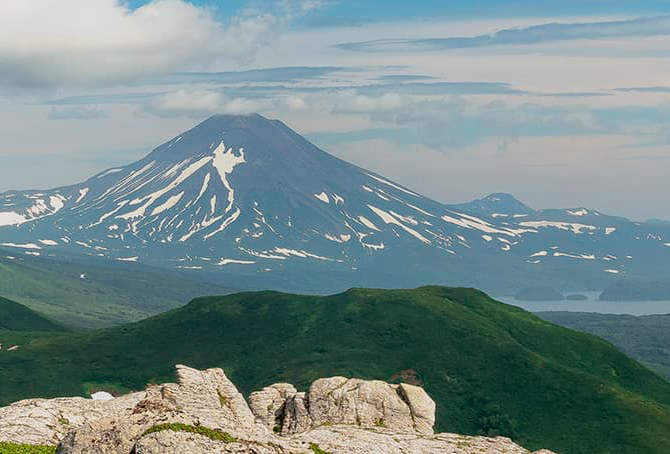
A story about the eruptions of the highest active volcano on our continent – Klyuchevskoy.
Klyuchevskaya Sopka is an active volcano on the Kamchatka Peninsula, the highest point in Eurasia, and one of the most powerful magnets for climbing enthusiasts. Its height ranges between 4,750 and 4,850 m above sea level, and its age has reached 7,000 years.
You can observe this volcano not only through photographs and footage of its eruptions: there are tour programs that take travelers to the foot of the giant and focus on viewing the lava fields and panoramas of the Klyuchevskaya group, for example, a tour around the surroundings of Klyuchevskaya Sopka with accommodation at its foot and without a technical ascent led by professional guides.
Klyuchevskaya Sopka is located in the center of the Kamchatka Peninsula and belongs to the Klyuchevskaya volcanic group, along with several other volcanoes. Visually, it is a giant of conical shape, which has been forming over many years and grows after each of its eruptions, thereby creating a stratovolcano. Klyuchevskaya is composed of lava flows and pyroclastic deposits. Its slopes are quite steep, about 33 degrees. The base of the volcano is 15 km in diameter, and the crater’s circumference is 600 m. It has about 80–90 flank craters and several lava flows of varying capacity. The summit of the volcano is covered with ice.

Eruptions of Klyuchevskaya Sopka occur every three to five years. They can last for several months. The eruptive products are highly viscous, which is why most eruptions are relatively calm. Today, volcanic material is emitted both from the main/central crater and from flank craters, whose number has already reached about 80. They are located at elevations from 400 to 4,000 meters.
The activity of Klyuchevskaya Sopka has been known since ancient times. The first recorded eruptions date back to 1737. Until 2016, about 55 eruptions had taken place.
The year 1932 was a turning point. From that time on, Klyuchevskaya Sopka changed its “eruption regime.” Previously, all known eruptions occurred from the central crater, but since 1932, against the background of its ongoing activity, flank eruptions on the slopes began to be observed. The first such event was recorded on January 25, occurring at an elevation of 500 m.

The most significant flank outburst was the eruption of 1938. Beginning on the eastern slope of Klyuchevskaya on November 7, it lasted for 13 months. The resulting 5 km long fissure gave rise to several explosive craters, at elevations from 1,000 to 1,900 m, which produced the largest geological effect in the entire history of the volcano’s eruptions.
A powerful ashfall, caused by a paroxysmal eruption, occurred in January 1945. In the same year, in mid-June, at elevations from 1,100 to 1,500 m, a chain of explosive craters formed along a fissure about 2,000 m long.
For 20 years, starting in 1946, flank eruptions on the slopes of Klyuchevskaya Sopka continued: 1946 – the Apakhonchich eruption, 1951 – the eruption on the Bylinkina cone, 1953 – the Belyankin eruption, 1953 – the Vernadsky and Kryzhanovsky eruptions.
The eruption that lasted from 1966 to 1981 brought Soviet scientists new phenomena that had not previously been observed. It all began with the opening of the Piip craters on October 6, 1966. The resulting fissure gave rise to a chain of explosive craters, the lower of which emitted a block lava flow for three months. On August 23, 1974, a new eruption began on the southwestern slopes of Klyuchevskaya, and the fissure that formed produced two flank craters at elevations of 3,600 and 3,400 m. Eruptions from the lower crater were characterized by block lava flows. Under the influence of the lava flow, a half‑kilometer glacier exploded, shooting up to a height of 500 m. This became the first documented example of such lava–glacier interaction for Soviet scientists. The subsequent eruption of 1980 was purely effusive, with low‑volume lava outpourings, and was named the “March 8 Eruption.”

The 1983 eruption was also distinctive. Its special feature was the persistence of a single eruptive center throughout the entire period (112 days), as well as the formation of lava tubes within the lava field. A lava tube is a kind of channel that forms due to uneven cooling of lava flowing down the slopes of a volcano. Its upper layers cool much faster and create a solid, heat‑insulating crust. Inside, the lava layers continue to move. Even after the eruption source cools, the contents of the tubes keep flowing, leaving empty spaces (tubes) behind and open entrances to them at the surface. The 1983 eruption was called the “Predicted” outburst.
One of the most large‑scale eruptions in terms of its consequences was the 1984–1987 event. After the “Predicted” eruption, a new scoria cone began to form in the main crater. Its growth was periodically accompanied by ejection of lava bombs to heights of up to 1 km. The crater floor filled with lava which, once it reached the lip of the crater, began to overflow down the slopes of the volcano. Eventually, the growth of the scoria cone became so great that it blocked the crater cavity and formed a new summit. Lava flows continued to pour out, and the style of activity periodically changed. Ash plumes rose to 15 km, allowing them to reach some layers of the stratosphere. Gas and ash plumes stretched for hundreds of kilometers. During periods of heightened activity, deep canyons in the glaciers were carved by muddy flows that spread up to 30 km from the foot of the volcano. Perhaps the most significant phenomenon was the formation of incandescent avalanches racing down the slopes at speeds of up to 100 km/h. The consequences of the eruptions were varied.

The year 1988 saw the “25th Anniversary of the Institute of Volcanology” eruption. At this time, a lava flow broke out at an elevation of 4,000 m, which became known as the Skuridin outburst.
September 7, 1994 is known for its summit paroxysmal eruption, which lasted almost a month. The most significant events took place on October 1. On that day, a huge ash column rose 13 km high from the main crater. It was accompanied by a fountain of incandescent bombs shooting up to 2.5 km. The size of the fragments falling to the ground ranged from 1 to 2 meters. Soon a vast plume of volcanic products spread above the volcano, and a whole wall of ash stretched toward the ocean. Lava flows reached the glaciers, after which a series of powerful explosions followed. Mudflows descending from the slopes of the volcano reached the Kamchatka River. This was one of the most spectacular eruptions in the entire history of Klyuchevskaya Sopka. After it ended, there followed eight years of calm.
By 2002, the volcano had awakened. Activity resumed, and 10 new scoria cones formed.
In 2005 and 2009, major eruptions occurred, lasting for an extended period. By 2010, the height of the volcano had for the first time reached 5,000 m.

One of the most recent eruptions of Klyuchevskaya Sopka dates back to 2013. On August 26, the first lava flow was recorded on the volcano. Between October 15 and 20, the ash column rose 12 km high. On that day, the volcano was assigned the Red Aviation Code, the highest level of danger for aviation. Strong ashfall occurred in the villages of Atlasovo and Lazo, where the ash deposits reached 2 mm thick. As a result of the eruption, glacier melting took place. Under its influence, a mudflow composed of water, ash, rock debris, and other volcanic material rushed down the Studenaya River. The Petropavlovsk – Ust‑Kamchatsk highway was temporarily closed.
April 2016 was marked by another eruption of Klyuchevskoy. For several weeks before the eruption, the number of small earthquakes increased from a few to hundreds per day. Increased internal rumbling associated with magma movement was also detected. The first lava flows were recorded that spring. For five months, ash plumes were observed rising to heights from 6 km to 11 km.
The closest settlement to the volcano is the village of Klyuchi. It was formerly a town with a population of 11,000 people. Now only about 5,000 remain. Klyuchevskaya Sopka constantly reminds residents of itself with an overhanging column of steam, ash, and gas.

On September 1, 1935, a volcanological station was opened in the village of Klyuchi, not far from the volcano, to conduct continuous monitoring of the Klyuchevskaya group. This observatory is the oldest in Russia and is located almost in the very heart of the village. It occupies a significant area. In addition to research facilities, it includes a guesthouse, a workshop, and a garage. There is also a geological museum, whose collection is constantly expanding. Among its exhibits are volcanic rocks such as lava from the 2012 Tolbachik eruption and a charred tree from the eruption of Shiveluch volcano.
Among the many photographs, the museum holds items commemorating the research vessel Boris Piip. For a long time, this ship was part of the regular fleet of the Institute of Volcanology.
The only piece of modern equipment here is a video monitoring system for Shiveluch and Klyuchevskaya Sopka. Images from space in this system are updated every minute. The rest of the equipment has been in use since Soviet times. Unfortunately, the number of employees at the station is gradually decreasing. In its best years, there were 40 staff members; now there are about 7.

Ready-made packages for your travel and vacation in Kamchatka
2027
2027

2026

2027

To book a tour or get advice about travelling to Kamchatka, write to us through this form. Manager Anastasia will reply to your enquiry shortly.
Анастасия

To book a tour or get advice about traveling to Kamchatka, write us through this form. Our manager Anastasia will reply to your request shortly.
Anastasia
To book a tour or get advice about traveling to Kamchatka, write us through this form. Our manager will reply to your request shortly.
Igor

The request was successfully completed, instructions are sent to your email