2027


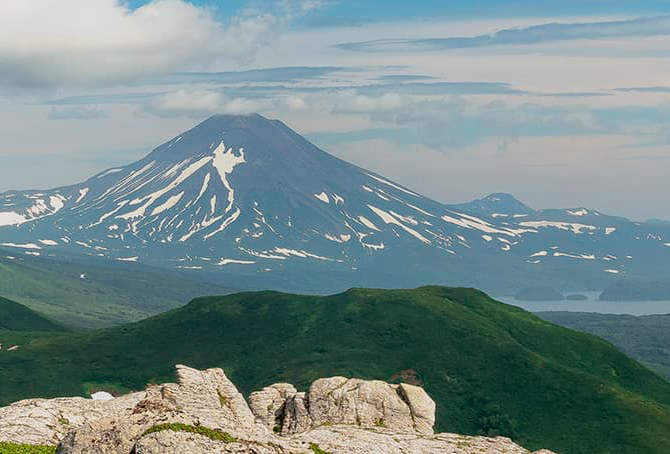
An inconspicuous volcano within the Klyuchevskaya group once made the whole world turn its eyes on it.
Once lost among its neighbors, an inconspicuous dormant volcano with barely visible outlines of a small crater is now one of the most famous, active, and closely monitored volcanoes not only in Kamchatka, but in the entire world. It is a natural monument and is located within the Klyuchevskoy Nature Park.
Bezymianny volcano in Kamchatka, also known as Bezymyannaya Sopka, belongs to the Klyuchevskaya group and is situated in its central part. The most famous active members of this group are Klyuchevskaya Sopka and Plosky Tolbachik.
Bezymianny volcano in Kamchatka, also known as Bezymyannaya Sopka, belongs to the Klyuchevskaya group and is located in its central part. The most famous active members of this group are Klyuchevskaya Sopka and Plosky Tolbachik, which are the focus of our trekking routes and tours around the Klyuchevskaya volcano group.
In appearance, Bezymianny is a broad elongated massif whose summit has been destroyed by a recent eruption. It is classified as an active volcano. The closest settlements are the village of Klyuchi, 60 km to the south, and the village of Kozyrevsk, 50 km away.
Most volcanoes in Kamchatka received their names from the local Itelmen people, and some were named after notable hunters and scientists. Bezymianny is an exception. During the period when the Kamchatka Peninsula was being explored, the volcano was “asleep”, so the lack of a proper name is associated with a long period of dormancy. In addition, compared to its neighboring volcanoes — Klyuchevskaya Sopka, Tolbachik, and Kamen — Bezymianny did not particularly stand out.
The formation of the edifice dates back to the Ice Age, which began more than 2.5 million years ago. In its place there were several domes formed by lava being pushed out onto the Earth’s surface. During scientific studies, these domes received names such as Smooth, Regular, Dissected, and so on. More than 10,000 years ago the older edifice, known as Proto‑Bezymianny, began to form, and about 5,000 years ago the present‑day Bezymianny appeared. The “remnants” of Proto‑Bezymianny have been preserved on the eastern side of the modern volcano, while the dome formed over 5,000 years ago is shifted about half a kilometer to the west.
Bezymianny’s activity has been observed in all periods. The dates of eruptions reconstructed from debris and the volcano’s structure show that in some time spans it remained active for up to 400 years. Activity peaks occurred in the periods from 2,400 to 1,700 years ago, from 1,350 to 1,000 years ago, and from 1955 to the present. The culminating phases of eruptions generally fall at the beginning and end of each active period. Such long‑lasting eruptions with catastrophic consequences tend to be similar in terms of eruption style and the lowering of the relief.
Today, Bezymianny volcano in Kamchatka has an elevation of 2,882 m. Before the catastrophic eruption of 1956, its height exceeded 3,050 m. The edifice includes a partially destroyed older structure on the southeastern flank of the younger cone and a crater measuring about 1.3 by 2.8 km in diameter. Before the 1956 event, only a weakly expressed summit crater was visible, and the volcano was considered extinct. The slopes are covered with numerous lava flows, and 16 domes sit at the foot. One of them, preserved from the early stages of activity, is called Plotina (“Dam”). The walls of this dome resemble stacked logs, which gave the place the name “Polennitsa” (“Woodpile”); it has the status of a natural monument.
The 1956 eruption placed Bezymianny among the most famous giant volcanoes on the planet. The study of its geological structure began in the 1980s with G. S. Gorshkov, while its several‑thousand‑year history was reconstructed through the work of O. A. Braitseva and V. Yu. Kiryanov. Later, scientific research intensified as the volcano’s activity increased and the available data proved insufficient.
One of the strongest eruptions in the history of the volcano — and of all Kamchatka — was the 1956 catastrophe. Hundreds of earthquakes per day, columns of fire and gas up to 40 km high, lightning, and a deafening roar. Impenetrable darkness from ash. The 1956 eruption was truly devastating not only for the volcano itself but for the entire surrounding natural complex. After this event at Bezymianny, this type of eruption was singled out by the international volcanological community as a separate class and is still known today as a “directed blast”.
The volcano poses a potential hazard to both international and local air routes that cross Kamchatka’s airspace: its ash plumes can rise up to 15 km, and ash clouds can stretch hundreds of kilometers in various directions. At present, the volcano has a yellow aviation alert code. Continuous visual, seismic, and satellite monitoring is carried out.
An interesting fact is the existence on the planet of another giant with a very similar eruption style (directed blast) — Mount St. Helens in the USA. According to scientists, St. Helens and Bezymianny may be related in some way. It was after the 1980 eruption of St. Helens that close monitoring of this “pair” began. The character of Bezymianny is also strongly influenced by its neighbors — Klyuchevskaya Sopka and Kamen. Collapses and movements within these volcanoes can directly increase pressure in Bezymianny and trigger rock avalanches. Volcanic processes in the Klyuchevskaya group are generally very vivid, and the composition of the rocks is constantly changing. Sometimes researchers find gold and platinum‑group elements here. The uniqueness of this group attracts both scientists and tourists, including mountaineers; every year many visitors follow the routes in this area.
However, the eastern sector of Bezymianny has little natural appeal. Here you’ll find scorching clouds, lifeless fields, buried lava flows, and heaps of boulders. Still, when weather, volcanic conditions, and safety regulations allow, it is possible to climb to the crater rim and admire the truly impressive panoramas of these places.
Ready-made packages for your travel and vacation in Kamchatka
2027
2027

2026

2027

To book a tour or get advice about travelling to Kamchatka, write to us through this form. Manager Anastasia will reply to your enquiry shortly.
Анастасия

To book a tour or get advice about traveling to Kamchatka, write us through this form. Our manager Anastasia will reply to your request shortly.
Anastasia
To book a tour or get advice about traveling to Kamchatka, write us through this form. Our manager will reply to your request shortly.
Igor

The request was successfully completed, instructions are sent to your email