2027


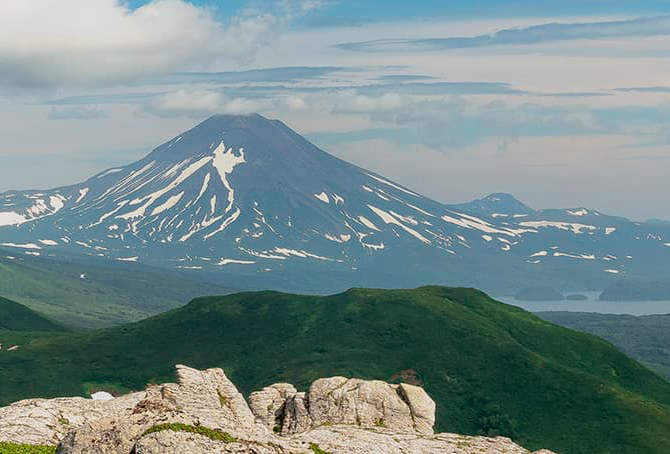
Did you know that the height of volcanoes is constantly changing? During eruptions, it can either increase or decrease.
Changes in the volcanic massifs on the peninsula are happening all the time. This is primarily due to Kamchatka’s location on the Pacific Ring of Fire, the movement of lithospheric plates, and the resulting eruptions.
If you don’t just want to read about Kamchatka’s volcanoes but also see them in person, take a look at our program to the foot of Klyuchevskaya Sopka without ascent — this itinerary lets you get as close as possible to an active giant while keeping the trip comfortable and safe.
The height of Kamchatka’s volcanoes changes after almost every episode of activity. Ash, gas, and lava emissions are often accompanied by sudden explosions, which can reduce a volcano’s height and create an enlarged crater.

All volcanoes of Kamchatka belong to two main volcanic belts: the Sredinny Range and the Eastern Volcanic Range. The latter contains most of the active giants. The highest point of this belt is Ichinskaya Sopka, with a maximum elevation of 3,621 m. It is the only active volcano of this mountain chain; the others either belong to the Sredinny Range or are located in the surrounding area. The lowest edifice of this belt is Shisheyka, at 379 m.
The next group, in the range up to 1,000 m, includes:
Kinenin (583 m), Terpuk (765 m), and Fedotych (965 m).
Volcanoes within the 1,000–1,500 m range include:
Shlen (1,001 m), Ozernoy (1,021 m), Lamutsky (1,198 m), Tunupiljanum (1,200 m), Kakhtana (1,217 m), Voyampolsky (1,225 m), Malaya Kytepana (1,230 m), Plosky (1,255 m), Tilmyg (1,265 m), Tekletunup (1,290 m), Mutny (1,315 m), Iettunup (1,340 m), and Elovsky (1,381 m),

Up to 2,000 m in height, you can find:
Maly Chekchebonai (1,261 m), Bolshoy (1,301 m), Leutongey (1,333 m), Bolshoy Chekchebonai (1,338 m), Bolshaya Kytepana (1,502 m), Kebeney (Keveney, 1,529 m), Langtutkin (1,534 m), Uksichan (1,550 m), Bongapchi (1,550 m), Titila (1,559 m), Mezhdusopochny (1,641 m), Uka (1,643 m), Grechishkina (1,651 m), Severny Cherpuk (1,679 m), Kayleney (1,680 m), Aynelkan (1,725 m), Kamenisty (1,758 m), Sergeyeva (1,759 m), Atlasova (1,764 m), Lelyakina (1,770 m), Slyunina (1,775 m), Payalpan (1,811 m), Anaun (1,828 m), Alngey (1,856 m), Bolshoy Payalpan (1,906 m), Chineyneyn (1,922 m), Severny (1,936 m), Ulvaney (1,954 m), Lagerny (1,961 m), Yuzhny Cherpuk (1,962 m), and Maly Payalpan (1,980 m).
Above 2,000 m, the following volcanoes are found:
Khangar (2,000 m), Novograblenova (2,000 m), Institute of Geology Volcano (Gorny, 2,024 m), Bely (2,080 m), Keveneytunup (2,133 m), Spokoyny (Kutiny, 2,171 m), Snegovoy (2,172 m), Snezhnoy (2,211 m), Iktunup (2,300 m), Shishel (2,525 m), Chashakondzha (2,526 m), Ostraya Sopka (2,539 m), Alney (2,581 m), Kuvkhoytun (Kuvkhoy, 2,618 m).
The second major mountain chain of the Kamchatka Peninsula, the Eastern Kamchatka Range, is divided into several groups:
The Central Kamchatka Depression, stretching for 750 km, includes: Khailyulya (1,145 m), Nachikinsky (1,211 m), and the active Shiveluch, which is the northernmost active volcano in Kamchatka.
The Kharchinsky group: Kharchinsky (1,410 m) and Zarechny (720 m).
One of the most famous volcano groups is the Klyuchevskaya group. Many of its volcanoes are among the most active and highest on the entire peninsula. This group is characterized by large volumes of volcanic deposits, up to 5,000 cubic kilometers. All major edifices are located on a shield‑type plateau known as the Klyuchevskoy Dol.
The active volcanoes here include:
Kizimen (2,485 m), Bezymianny (2,866 m), Plosky Tolbachik (3,140 m), and Klyuchevskaya Sopka (4,750 m), which is the highest volcano in Kamchatka.

Also located on the Klyuchevskoy Dol are:
Nikolka (1,591 m), Malaya Udina (1,945 m), Malaya Zimina (2,242 m), Kuvkhoy (2,618 m), Ostraya Zimina (2,744 m), Bolshaya Udina (2,943 m), Srednyaya Sopka (2,978 m), Ovalnaya Zimina (3,081 m), Ostroy Tolbachik (3,682 m), Dremlyushchy Krater (“Dormant Crater”, 3,943 m), Ushkovsky (3,943 m), Krestovsky (4,057 m), and Kamen (4,575 m).
The Eastern Kamchatka group includes:
Kikhpinych (1,552 m), Krasheninnikov (1,856 m), Shmidt (2,020 m), Komarov (2,070 m), Kolkhozny (2,150 m), Gachmen (2,576 m), and Kronotskaya Sopka (3,528 m).
The Uzon–Geysernaya depression unites the Uzon and Geysernaya calderas. Its rim is marked by a pronounced scarp that follows a ring fault.
It includes:
The Geysernaya caldera and the Valley of Geysers itself, Burlyashchy (1,100 m), Centralny Semyachik (1,200 m), the Uzon caldera (1,617 m), Bolshoy Semyachik (1,720 m), Unana (2,194 m), and Taunshits (2,353 m).

The Karymsko–Malosemyachik volcanic‑tectonic depression includes:
Akademii Nauk volcano (1,100 m), Dvor (1,485 m), Karymskaya Sopka (1,486 m), and Maly Semyachik (1,560 m).
The Zhupanovsko–Dzendzur group consists of just two giants — Zhupanovsky (2,958 m) and Dzendzur (2,159 m), which together form a single mountain ridge dissected by volcanic formations.
The Avachinsko–Koryakskaya group
This is another well‑known group of “home” giants, which includes:
Arik (2,156 m), Kozelsky (2,190 m), Aag (2,310 m), and the active volcanoes Avachinskaya Sopka (2,741 m) and Koryakskaya Sopka (3,456 m).
The Eastern Range
The volcanoes in this group have been heavily eroded by their most recent historical eruptions and are not currently active.
Iult (1,224 m), Vachkazhets (1,556 m), Zavaritsky (1,647 m), Konradi (1,893 m), Tumrok (2,092 m), Bakenin (2,277 m), and Shish (2,346 m).
The South Kamchatka group
This group includes more than 600 small volcanic formations and about 80 major ones, the best‑known of which is Vilyuchinsky (2,175 m).
The Tolmachev Dol depression
In the center of this depression lies Lake Tolmacheva, surrounded by the calderas of the following volcanoes:
Tundrovoy (736 m), Zhelty (885 m), Bolshaya Ipelyka (1,139 m), Karymshina (1,363 m), and Tolmacheva (1,415 m), as well as Gorely (1,829 m), Asacha (1,910 m), Mutnovskaya Sopka (2,323 m), and Opala (2,475 m).
Another volcanic‑tectonic depression is formed by the volcanoes Kellya (985 m), Ksudach (1,079 m), Piratkovsky (1,322 m), and Khodutka (2,087 m).
The Pauzhetsko–Kuril volcanic‑tectonic depression, in turn, “hosts” the caldera of Kurile Lake and the volcanoes Dikiy Greben (1,079 m), Ilyinsky (1,578 m), Kosheleva (1,812 m), Zheltovskaya Sopka (1,953 m), and the 2,156‑meter‑high Kambalny.
Ready-made packages for your travel and vacation in Kamchatka
2027
2027

2027

2027

To book a tour or get advice about travelling to Kamchatka, write to us through this form. Manager Anastasia will reply to your enquiry shortly.
Анастасия

To book a tour or get advice about traveling to Kamchatka, write us through this form. Our manager Anastasia will reply to your request shortly.
Anastasia
To book a tour or get advice about traveling to Kamchatka, write us through this form. Our manager will reply to your request shortly.
Igor

The request was successfully completed, instructions are sent to your email